OCD Stereotypes: Is Media to Blame? (Part I)
OCD as portrayed by the media can be harmful. In what ways is it harming individuals with OCD? What can we do about it? Join me in this reflection.


Most of us are aware of the way OCD is portrayed in the media and understood by the general public. These portrayals are found in films, television, and online content. In the latter it is often reduced to jokes about organizing pens by size or describing someone as "so OCD". There is no shortage of misrepresentations of the disorder.
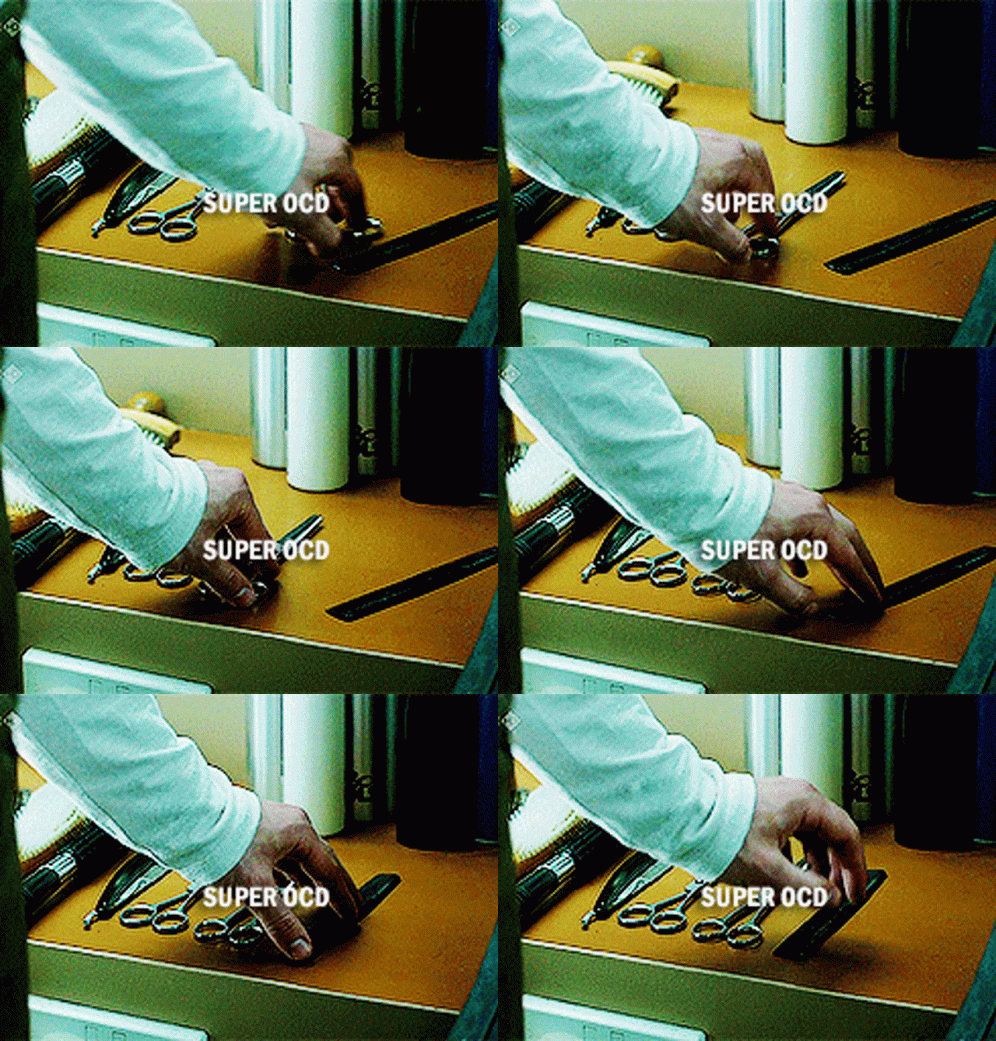
At first glance, this may not seem particularly problematic. These references are often made casually or framed as entertainment, and pointing out their consequences can be seen as dramatic or pedantic. This raises an important question: are we focusing on the wrong thing when we criticize television series like Monk or social media platforms for misdefining OCD and reducing the credibility of the disorder?
In this post, I do not aim to answer such a broad question definitely. Instead, I wish for you and I to reflect on common mischaracterizations of OCD, why they matter, and their potential consequences. Part two of the post will describe what OCD actually feels like, so please stay tuned for that.
Defining Obsessive‑Compulsive Disorder (OCD)
OCD is a mental disorder involving the existence of obsessions and compulsions. Obsessions are repetitive and intrusive thoughts, mental images, and urges, which are unwanted and anxiety-inducing [1]. Compulsions are a response to obsessions and they serve as a brief anxiety relieving mechanism by urging an individual to act out repetitive behaviors or mental acts. Additionally, OCD symptoms are typically inconsistent with the person's values (ego-dystonic), which is partly why this mental condition causes so much distress. ( For a more complete definition click here).
Why should we care?
Consistent mischaracterization, whether through trivialization or sensationalization, can and does decrease the perceived seriousness of a mental disorder, especially when the general public has little knowledge of it [3]. For individuals with OCD, this can translate into additional barriers to seeking help, layered on top of existing mental health stigma [2, 3, 4]. Adults with OCD have pointed out that public images minimizing the disorder to a 'joke condition' has lead to people's lack of understanding of the distress they experience daily [4]. Additionally, researchers have shown that the lack of understanding from the public regarding the difficulties caused by OCD can cause a delay in seeking help from 3 months up to 8 years [4].
Again, this isn't just the case with OCD. The same theme of issues is present among other conditions, such as addiction, schizophrenia, and borderline personality disorder. These mental health conditions are frequently misrepresented to the point that we are not talking about a disorder anymore, but in the case of movies or TV-shows, a set of fictitious traits that make up the main crux of a fictional character.
"OCD isn’t just having your pens in a like coordinated order and saying, ‘oh, I’ve got OCD’. It’s more serious than that. . . It’s a lot of stuff. It’s a much wider broader thing than people think really and that it’s much more serious." - Tobias (teenager) extracted from [4, p. 180]
Monk - the problem or a symptom?
For those unfamiliar, Monk is a comedy-drama mysteries series with Adrian Monk as its main character. Monk is an exceptional detective with several phobias and severe OCD, which in the show, is partly why he is such a great detective. This mischaracterization goes so far as to call OCD a gift and curse at the same time. This is problematic, especially given the fact that the series' final episode was watched by 9.4 million people and had an average viewership reportedly around 4 to 5 million.
By their very definitions, mental health conditions, not just OCD, impact daily functioning at varying levels by negatively affecting thinking, feeling, mood, or behavior and cause significant daily distress. This means that any mental health disorders come with not only, no benefits but disadvantages to one's capability of, for example, feeling joy. This does not sound like a gift. In fact, any hypothetical benefits that may come with having a mental health condition are vastly outweighed by its drawbacks. This is one of the ways how a depiction of one disorder can impact overall views on mental health and the capacity people have to empathize with individuals who suffer from these disorder or even themselves.
I would like to refer to the opinion some individuals with OCD had regarding the series: “Other respondents felt that the humor was good-natured, provided an opportunity to laugh about a stressful topic, and may have appealed to people in ways that a serious portrayal would not” ([1], p. 165).
Everyone is entitled to their own opinion and this post is not about saying that someone is wrong or even attributing blame, but assessing an issue objectively. However, the part that jumps out at me is the statement that a serious portrayal of OCD could not appeal to people in the same way. We, as viewers, are not passive recipients of content, but have our own filters that come together through our own personal identities, experiences, and beliefs, which may result in different interpretations, not only between viewers but also between the viewer and the writer/ director. Hence, you and I interpret the same show, episode, or scene differently. What I want to do here is give my own opinion on the matter.
I believe, the use of humor would perhaps be okay or even prudent if there was "enough" realism to the portrayal and the other aspects circulating, such as OCD treatment that Monk receives. However, the series fell short in this aspect. Hence, if the show does not accurately portray the mental condition then it does not appeal to it. It appeals to a fantasy of what the disorder is, not even a caricature (not that it would be much better). Perhaps this opinion is pedantic and it indeed is the case that it is a TV show so one cannot expect to there not be dramatization and exaggeration of the the very thing the show is about. If this was the only example of mischaracterization of the disorder then this question could perhaps be labelled as pedantic. However, this is not the only instance of mischaracterization (please read this post for more examples).
What I am attempting to do here is not place blame on one single show, movie or online content, instead I am trying to get to the crux of the problem. When is it enough? How much can you stretch the portrayal of a mental condition until you are talking about something else entirely? Should writers, directors, and producers be more socially responsible regarding accurate portrayal of disorders?
At the moment, I am not sure if I can answer all these questions confidently, but I do believe all of us would benefit from more social responsibility. I also think that our focus should be placed elsewhere. In fact, I believe that talking too much about this very issue borders on waste of resources (ironic). What I believe we need is to educate the general public and, at the same time, to have a dialogue about mental disorders. One cannot exist without the other. We cannot force people to believe in something, we need to meet them where they are at, without judgement. Additionally, we can point fingers all day and discuss these issues endlessly, but reflection without action does not lead to any meaningful change. Fortunately, there are some examples of accurate portrayals in media of OCD such as Turtles all the Way Down and The Aviator. We are not totally hopeless.
Reflection on the role of entertainment in informing the view on mental disorders is still important as it is part of our culture, therefore addressing the damage, and potential benefit, they can have is crucial.
If we want to help individuals with OCD to get better, which includes young people, adults, and the elderly, shame and stigma regarding OCD needs to be addressed. Education of the public, medical professionals, and educators should be a priority stated [4]. Moreover, this is even more imperative for children and people living with their family as family accommodation is a crucial aspect of the success in treatment, quality of life, and more.
Thank you for taking the time to read my post,
João Carvalho
Sources
[1] D. J. Stein et al., “Obsessive–compulsive disorder,” Nat Rev Dis Primers, vol. 5, no. 1, p. 52, Aug. 2019, doi: 10.1038/s41572-019-0102-3.
[2] Hoffner, C. A., & Cohen, E. L. (2018). A comedic entertainment portrayal of obsessive–compulsive disorder: Responses by individuals with anxiety disorders. Stigma and Health, 3(2), 159–169. https://doi.org/10.1037/sah0000083
[3] Stewart, E., Grunthal, B., Collins, L., & Coles, M. (2019). Public Recognition and Perceptions of Obsessive Compulsive Disorder. Community Mental Health Journal, 55(1), 74–82. https://doi.org/10.1007/s10597-018-0323-z
[4] Keyes, C., Nolte, L., & Williams, T. I. (2018). The battle of living with obsessive compulsive disorder: A qualitative study of young people’s experiences. Child and Adolescent Mental Health, 23(3), 177–184. https://doi.org/10.1111/camh.12216
Disclaimer: Everything I share here comes from personal experience and what I've found helpful. This isn't a substitute for professional advice—if you're struggling, I truly encourage you to reach out to a qualified mental health professional.